Reading the vertical text with Rainer Turim; or, the meaning of graffiti in hypergentrified New York
Rainer Turim on the graffiti writers who push the limits of their bodies and the city to keep the illicit practice alive and thriving.

“I do think that graffiti tags can be read as kind of tombstones of the city. And more specifically of graffiti writers themselves. There’s kind of the opposite of a graveskeeper, people buff tags and they don’t know that that person died, and they probably wouldn’t care, because it’s vandalism. Or maybe the building will get torn down like ABC No Rio.”
When I look out my kitchen window, I see the names signed onto the neglected box truck across the street like it’s a guestbook. DEST, LOPEZ!, GUNK, and, of course, ZOOT. The once-white truck on my block, along with the plumbing supply workshop next door, is a well-worn canvas for Brooklyn’s graffiti writers. Their imprints spill down my street, around the corners, and up to the tops of buildings, begging the question to the contemplative viewer: How did they get up there?
I love the writings on the walls. They’re expressions of the human instinct to leave behind images, letters that offer new variations on the same old alphabet, windows into a subculture that, while completely foreign to me, is clearly thriving in postmodern New York. The tags are signs of life in the neighborhood; graffiti writers leave their tags here because there are people around to notice them, a place to see and be seen.
But while some names have become familiar (i.e. ZOOT), they’re essentially all strangers to me. I don’t know these tags because I don’t have the learned eye of the graffiti appreciator, the encyclopedic knowledge of the tag connoisseur. For that, I go to Rainer Turim.
Rainer is a writer, photographer, East Village native, and, in my estimation, eminent expert on New York City graffiti culture. Almost exactly one year ago, he wrote WHEN A WRITER CLIMBS WALLS, a zine published by misplaced press documenting vertical rappel graffiti—that is, graffiti painted down the sides of buildings using climbing equipment—about the style’s proliferation and the writers across the world who risk their lives to make their mark on the built environment.
His writing and perspectives on graffiti revealed a new layer of the city’s surfaces, the anonymous characters behind the tags left by daring climbers who operate under the pale of night. Walking through the city with him can become an eagle-eyed tour of the standouts of the graffiti scene, pointing out the pieces hidden in plain view: a WOMBAT on a doorframe, a Benzine SK behind a citibike rack. On our way out of this interview, he stopped and had me take a photo of hat-trick door on East 9th tagged by WOMBAT ICBM, NOTICE, and (of course) ZOOT because his phone had died.
Rainer has also written and published on Keith Haring’s murals at PS 97 on the Lower East Side, independent used bookstores in Brooklyn, and writes about photography and photo books on Substack.
I know you took an interest in graffiti writing and then your attention turned to rappel. Can you walk me through how you came to focus so deeply on graffiti in the city?
I started being more cognizant of graffiti writing in 2014 or 2015 when I started walking around with my parents’ Nikon DSLR and taking pictures strictly of graffiti stickers. The first graffiti writer that stood out to me wrote “Jim Joe.” And then there was this person who wrote with him—or maybe was him—who wrote “Womp Womp.” And they would write all over the city in these hard-to-get-to places, like on the sides of buildings. But they would probably just hang over the ledge of a building and write upside down.
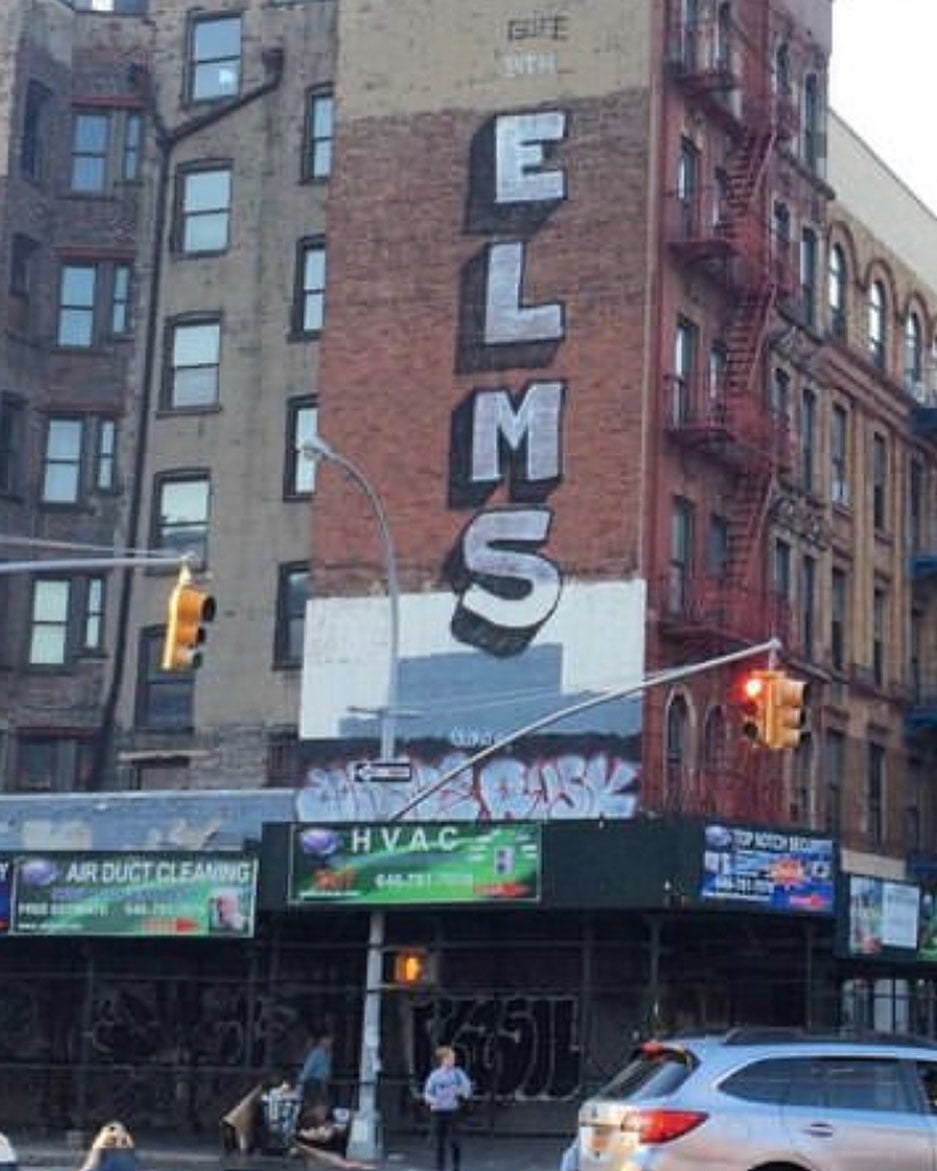
I was photographing that for a while. During that time, I would commute to high school walking down Houston Street toward the East River, and there were a few really jaw-dropping graffiti pieces on the northwest corner of Avenue B and Houston Street. One particular piece was ELMS, a vertical piece which seemed so different than any other graffiti I’d seen. It was so vividly confusing that it made you wonder how someone could write like that. It made you think that it was almost a professional or commission job because it was so refined and it wasn’t sloppy. But because it was a graffiti tagger’s name, it had to be the responsibility of one person. It was just really cool to see something that I couldn’t understand in the context of graffiti and wondering how someone could write that.
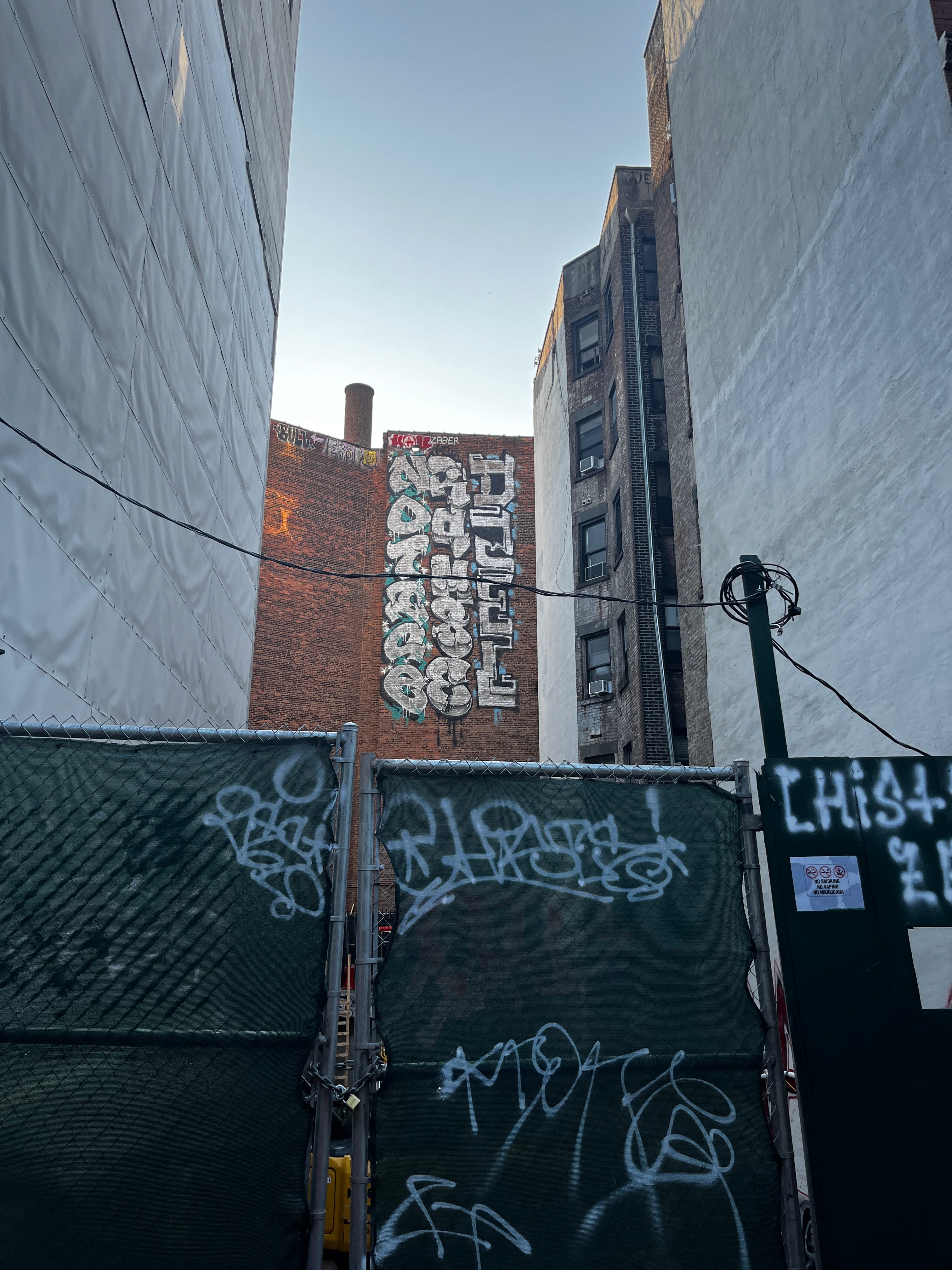
And then it wasn’t until the last couple years that I started seeing more vertical graffiti. What was fascinating about this was that they would paint next to each other and beside each other; you had these people who were rappelling together, and it became this kind of group of tags, and they had their own defined style.
Like QZAR would paint with this Ukrainian graffiti writer SETO, and they would paint in the same color green but have such varying styles. But they would paint literally side-by-side. Then you had other graffiti writers like ZOUF and NOTICE who would kind of paint in a matching typeface in the same color, this kind of matching that felt a lot more new.
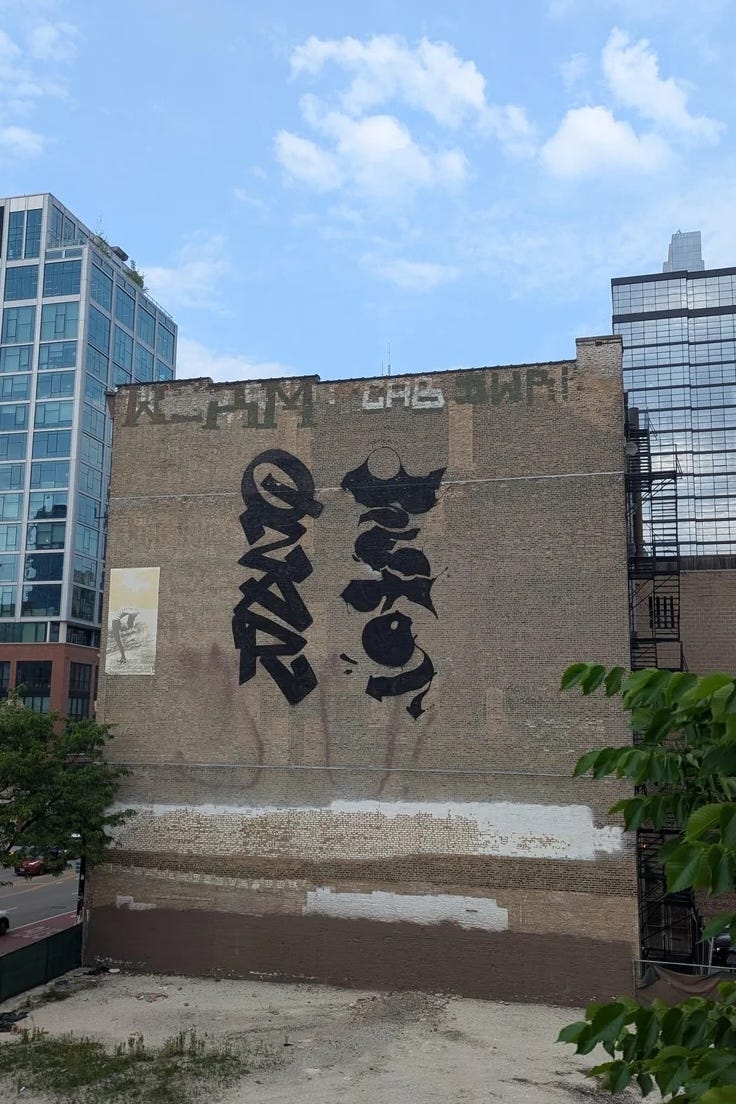
All these people who have their own unique rappel style, like ZWON paints these incredible dioramas in their rappel pieces, which look similar to, as my friend Lei Takanashi would say, Colossal Media.
But ZWON and even QZAR and some others had this impressive style for doing it all on their own, without this veil of authorization or permission being commissioned, or even frankly welcomed.
Graffiti is entirely selfish, because you’re demanding that people look at your tag. But I say that with no judgment or any kind of ethical critique on what they decide to do. It just seems kind of obvious that if you paint graffiti, there is a value at which you think that people should see your writing. And with rappel it feels so interesting because it blurs into the lines of advertising so closely that some of my friends, even after looking at certain graffiti writing, wonder if it’s an advertisement because it feels so well done.
I think there’s an association of graffiti, especially in New York City, with an era of a grittier New York and an era of the city when the subway cars were covered in graffiti, and discarded property downtown is totally covered with people’s writings and painting.
Obviously graffiti has been done for time immemorial, but in New York in particular, there’s an association with probably the 70s and the 80s, an attachment to hip-hop culture, and the emergence of a very local and guerrilla art subculture that people started doing.
I wonder what you think about the persistence of graffiti and even the stylistic continuity of what graffiti looked like in the 80s in a very different version of downtown Manhattan to what we see around now as the city has transformed in the way that it has. To write graffiti on Houston Street is to be writing on some of the most expensive real estate in the world, whereas a few decades ago it was a fundamentally different context.
In the 70s, you had Martha Cooper and Henry Chalfant photographing these graffiti writers who were bombing subway trains, and those subway trains would go all over the city. And people would be sitting on the writers’ bench in uptown Manhattan and watch their friends and other graffiti writers pass by, and they would photograph it and critique each other. There would be this kind of community: you had Henry Chalfant’s studio down on Canal Street, and graffiti writers would tell each other to come by, Henry would invite graffiti writers to come. And you had this very public forum of graffiti writing, and it all kind of went back into this kind of tight community with Martha Cooper and Henry Chalfant’s books, and then Charlie Ahern and Tony Silver’s movies that would come out at that time. You got a much wider recognition of graffiti writing.

But there is something very different about the process by which people look at graffiti now and the way it gets processed into this kind of shareable object. There isn’t a rappel graffiti book being made by Martha Cooper and Henry Chalfant today, but I don’t think there is the same need for that. What that book did for people, from my understanding, was promote this expression of graffiti writing and validating its existence. Behind the advent of rappel graffiti is this legitimacy of graffiti. Not in the sense that private property owners and private property won’t hate it, but the fact that it can transcend property.
In the 70s and 80s, you had these high school-age graffiti writers—I can’t imagine them climbing a building and rappelling it. That wasn’t part of its culture, and to do it might even take it too seriously.1
To speak to the gentrification of downtown Manhattan, where Zoot and XSM and all these graffiti writers paint on these luxury buildings that have arisen in Chinatown and the Lower East Side. You could look at it as an echo to an earlier New York that was covered in graffiti tags.
But also, you can’t look at graffiti without looking at the buildings that it appears on. At ABC No Rio, the artist collective co-op, a graffiti writer named SANE wrote in the backyard. And when they demolished the building when I was in high school, they excavated and saved the bricks that Sane painted on.
I try to keep an eye on how much graffiti proliferates on auctions and eBay, but I have not seen any graffiti bricks that have been saved from the 70s or 80s. Now you look at eBay listings and you see people cut out tarps that graffiti writers have painted on in the last couple of weeks. It speaks to this larger question of how people see graffiti as something to profit off of. Not the writers themselves, but people who are witnessing it. I think it’s folded into the question of what graffiti looks like in a gentrified New York, but also graffiti has become this kind of gentrified quality where there’s exhibitions on graffiti now. And the same graffiti that used to be subversive and countercultural and get painted over is now in auction houses.
You can look at Keith Haring, you can look at Basquiat and Al Diaz who wrote SAMO, you can look at all the people that wrote graffiti understanding the fact that it was temporal and would fade. I’m not sure how they would feel with the kind of obsessive current phenomenon of wanting to commodify something that was illegal and would get them in jail back then, but now sell hundreds of thousands to private collectors who own property and would be extremely angry.
Not to call current graffiti writers today’s Keith Haring or Al Diaz or Basquiat. They’re their own individual practitioners. But there is this irony of it that feels so confusing, but I think it’s impossible for these contradictions to not exist.
A lot of graffiti, if you think about it, are kind of tombstones. Whether it’s an old New York that used to exist, in which that graffiti could proliferate, or a New York that graffiti writer could only exist in that moment, or tombstones for even the graffiti writers themselves.
What do you mean by that?
I mean, graffiti writers die. The idea of someone having multiple tombstones sounds silly, but the fact that certain graffiti writers’ tags and spots have outlived the tagger’s existence is a kind of crazy phenomenon. In the instances of graffiti writers who [died], maybe it’s a Brazilian who wrote so exhaustively that they died while tagging, these tags kind of have these connotations of achievement.
But I do think that graffiti tags can be read as kind of tombstones of the city. And more specifically of graffiti writers themselves. There’s kind of the opposite of a graveskeeper, people buff tags and they don’t know that that person died, and they probably wouldn’t care, because it’s vandalism. Or maybe the building will get torn down like ABC No Rio.
There’s other situations where when I walk by Avenue B and Houston Street, where that ELMS tag used to be, I don’t believe it’s the same building anymore. But then I walked by the other day and there’s a NOTICE tag that’s on the same side that that ELMS tag used to be, and it feels like an echo to that moment.
The graffiti tags and the buildings themselves kind of create this—it maybe is too pretentious to call it kind of poetry, but this kind of story of the city and graffiti itself. Especially because it can be coincidental or happenstance.
You can’t really compare the hatred of graffiti in the 70s and 80s to now because that hatred is interwoven with these other frustrations with the city—feeling abandoned by their landlord and a city that’s bankrupt.
Is that true of the writers who are at it now?
Some people may get really in the weeds of “who is this graffiti writer, what background are they coming from, where are they from? Are they from New York?” You have a graffiti writer like Dash Snow who had a documentary made about him, and it was very publicly known that he had a wealthy background, but then ran away from it.
The question of someone’s class and wealth with graffiti I think is obviously an interesting question. But in terms of the global bigger picture, it’s harder to focus on, and I think if you’re talking about graffiti generally it’s harder to know, because the kind of accessibility of graffiti and people writing graffiti now is so different.
You could more ascertain where graffiti writers were coming from then because you didn’t have such an influx of people coming to write graffiti or come here and then write graffiti. It is such a transient culture now.
A lot of people, when I’ve talked about rappel graffiti, they associate it with this European graffiti writing process. I talked to Sean Vegezzi, an artist who makes a lot of artwork about the urban environment and the human capacity to, not necessarily take it over, but immerse oneself in its underground environment. And he thought that a lot of this rappel interest came from the kind of blue-collar work like painting or cleaning windows and using that similar equipment. But then there’s also this crunchy granola interest in rock climbing and mountaineering that also could be a path to using that same technique and process with a building to paint graffiti.
Has New York become a destination for graffiti writers?
Maybe some people come here with the intention to write graffiti, but some people just come here and end up writing graffiti because of other things going on. It’s just so transient that it’s harder to ascertain or create the kind of connections—in the 70s or 80s you had people who grew up in New York and painted graffiti, different neighborhoods came out with different writing styles.
There is a quality In graffiti now of what New York City used to be. Maybe it’s nostalgia, there is a cultural history that feeds itself into graffiti writing now. Whether it’s like Barry McGee saying that Keith Haring and Basquiat were inspired by graffiti writers before them; the throughline continues and becomes, I wouldn’t say harder, but there’s people who wrote graffiti because their parents wrote graffiti. Zexor—rest in peace—he wrote graffiti and his father wrote graffiti.
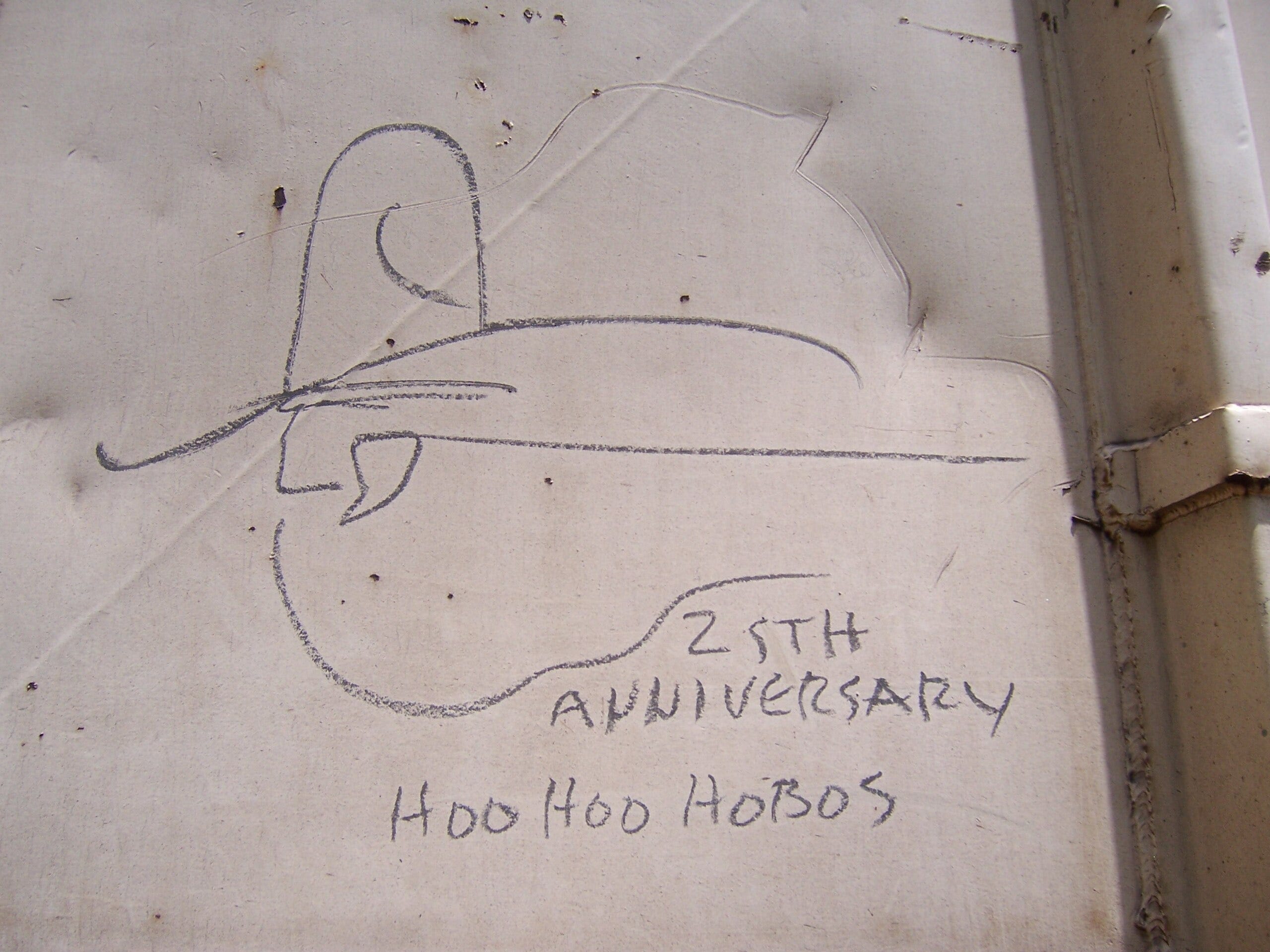
But to grow up after the phenomena of graffiti becoming—I don’t know the word, profitable or this cultural entity—it’s just so much harder to track. I don’t think there is one timeline of graffiti writing because you could go back so far. There’s people who wrote on freight trains, the culture of hobo writing. But then you also had people who worked on the trains writing graffiti on those trains—there was this surprising element of people who work on the trains like the late Colossus of Roads, he was a train worker but he also carried around a piece of chalk that he wrote graffiti with.
That really echoes what you were saying with rappel graffiti and people associating with people working on window washing and building maintenance suspended on the sides of buildings and utilizing that position
There is a superhero quality to a lot of this, which is the fact that somebody who maybe by day cleans windows, by night paints their name on a 10-story skyscraper.
The anonymity and mystery of graffiti writing will always continue for that reason. The idea that someone by day is a different figure at night. And the same thing in the fact that you still might get caught. Like a train worker who writes their name doesn’t want to get caught because they’ll lose their job, and they’re also taking advantage of a situation that they shouldn’t be.
This idea of risk that there’s a hustle with graffiti that’s utilizing what you can, and maybe the abilities that you have. Even going back to hobo writing and moniker writing, it’s utilizing what you have access to and when you can. I don’t think that’s an element of graffiti that will ever change as well. Because it’s an admirable and awestriking quality.
When I talked about earlier about the idea that someone is selfish who writes their name, they also go out of their way to do something that they may never publicly take credit for. So there is this kind of contradiction when they’re not writing their government name. I think that’s an amazing quality about it.
Tangent from Rainer for the interested reader: I just don’t think rappel graffiti could have existed in that era. In Tijuana, Mexico, there is this style of graffiti called Trapes, or Trapadoras—trapes, like to climb. And people will hang over buildings and write upside down.There’s this kind of leaderboard where whoever can hang the lowest off a building and write underneath someone else who has written, that’s a true writer. People will hold each other’s legs and create their own kind of rappel equipment that may or may not protect their life. But there is this extreme DIY creativity—maybe education is a word for it—that people are acting on. With the Tijuana Trepes, you can find videos on YouTube from the 2000s of people creating their own rappel equipment and abseiling with ropes.